
Long Read 8 min read
How Sage grew from a Newcastle printing business into a global software company
Founded in 1981, Sage became one of Britain's largest technology companies by making business accounting simpler.

Graham Wylie used to attend lectures at Newcastle University wearing a suit and tie. Afterwards, he would head to the Quayside to meet clients.
He was studying computing and statistics, but had already begun working on software that would help change how small businesses managed their accounts. He had little knowledge of accounting itself.
“I didn’t understand debits and credits at the time,” he recalled in a 2024 interview with Luxe magazine. He believed that inexperience helped him design software ordinary business owners could understand.
The company that emerged from those early assignments was Sage. Founded in Newcastle in 1981, it would become one of Britain's largest software groups, establishing an international business while keeping its headquarters in the North East.
Its journey began with a printing business, an entrepreneurial owner and a problem that needed solving.
A business born from a practical problem
David Goldman was running Campbell Graphics, a Newcastle printing company specialising in magazines. Estimating the cost of jobs, preparing quotations and managing accounts involved substantial manual work.
Goldman saw an opportunity to use the emerging technology of personal computers to make those tasks easier.
He brought together computer expertise from Newcastle University, including American specialist Paul Muller and Wylie, who had already developed accounting software during a student placement.
Wylie was the son of a coal miner and had grown up in Whitley Bay. He had found a summer programming job to help finance his studies. That assignment led to work for Goldman and eventually to the software that became Sage Accounts.
Goldman recognised that other printing companies faced similar problems. The software could become a product in its own right.
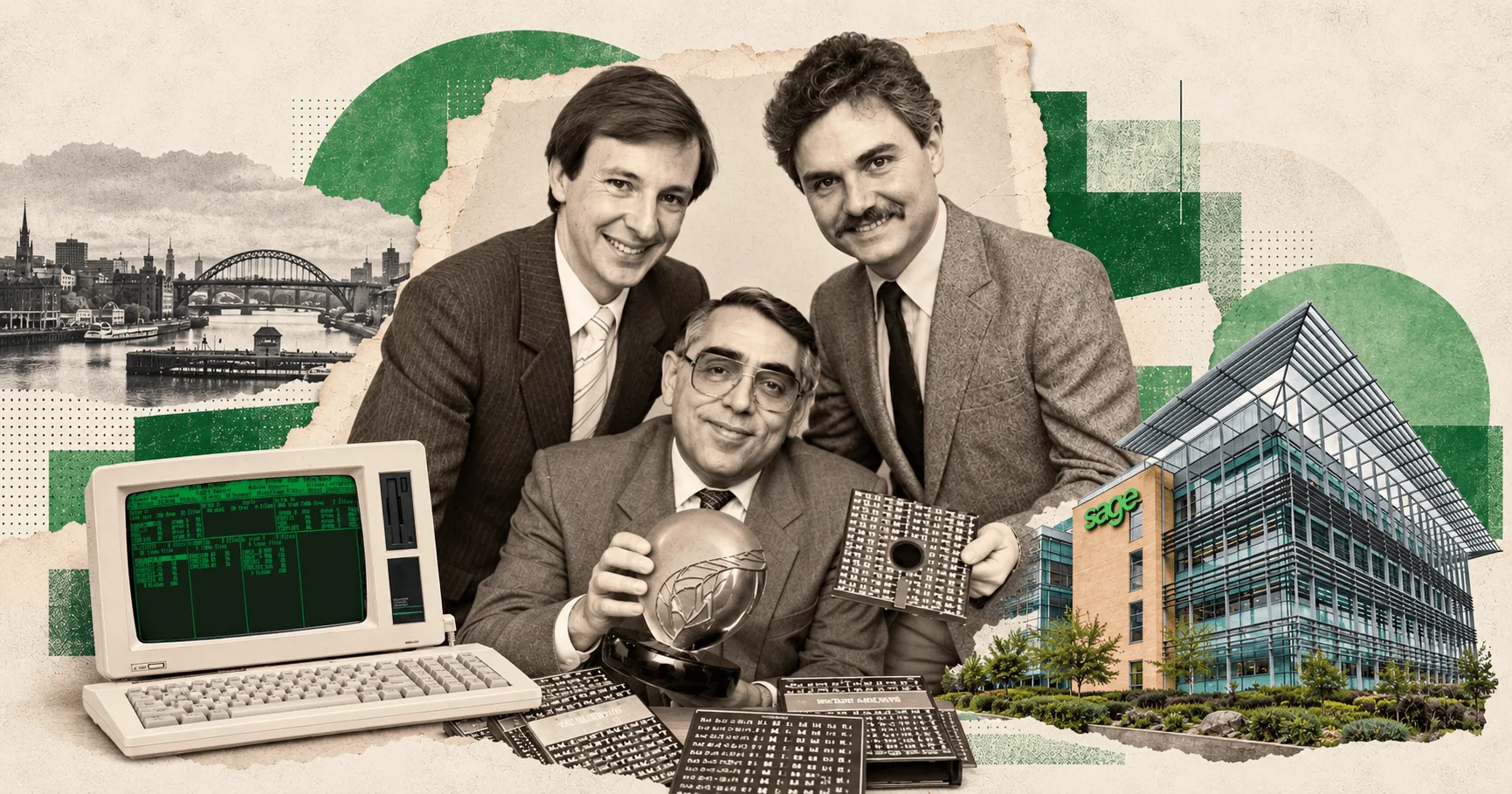
Sage was established in 1981, with Goldman, Muller and Wylie among the people behind the new business.
The timing was significant. Personal computers were beginning to enter workplaces, but business software was still relatively unfamiliar to many smaller companies. Accountancy programmes had often been designed for specialists rather than owners trying to run their businesses.
Wylie's lack of formal accounting training helped shape Sage's early approach. His aim was to make the software intelligible to someone who needed to manage money without being an accountant.
There was another important influence. Goldman understood his customers because he had been one himself.
His son Daniel Goldman offered an unusually personal account of Sage's beginnings in a 2011 essay marking its 30th anniversary. His father, he wrote, believed Sage was fundamentally “a marketing company that happens to sell software”.
It was an approach that would influence the company's development for decades.
From the A1 to the Amstrad
Selling software in the early 1980s was considerably harder than distributing it today.
Newcastle University's account of Wylie's career describes the founders travelling up and down the A1 in a Chrysler Alpine, visiting prospective customers and demonstrating their products.
It was an exhausting way to build a national business.
They eventually decided to establish a network of resellers who could sell Sage software locally, supported by telephone from Newcastle. That allowed the company to reach far more customers without sending its own staff across the country.
Tom Maxfield joined Sage as sales director in 1984, three years after its founding, and helped turn it into an international business.
Sage initially sold computer hardware alongside its software. Machines from manufacturers including Osborne and Apricot formed part of its offering. But the founders decided to concentrate on software, where margins were better and the business required less capital.
The next breakthrough came in 1985.
At the Personal Computer World exhibition in London, Goldman encountered the Amstrad PCW 8256, a relatively affordable machine aimed at people who wanted to use computers for practical work.
He recognised its potential. Sage moved quickly to adapt its accounting software for the machine, opening the product to a much larger market of small businesses.
The decision helped transform Sage's prospects. As personal computers became more accessible, accounting software was no longer something only larger businesses could afford.
The company was developing a commercial formula built around accessible products, local distributors and ongoing customer support.
Taking Newcastle software around the world
Sage floated on the London Stock Exchange in 1989 with a valuation of around £20m.
The listing provided access to capital and helped support a new phase of expansion. The company had established a strong position in Britain, but its management recognised opportunities in other countries.
There was an obstacle, however. Business accounting was not the same everywhere. Different tax systems, reporting requirements and commercial practices made it difficult to sell one standard package internationally.
Sage's answer was to buy established local businesses.
In 1991 it entered the United States through the acquisition of DacEasy. The following year it moved into France through Ciel.
These businesses already understood their domestic markets and had their own products and customers. Sage could retain that knowledge while applying its experience of distribution, support and recurring income.
Paul Walker became chief executive in 1994, having joined the company as its accountant a decade earlier. He oversaw much of the international expansion that followed.
In a 2000 interview with The Independent, Walker explained the company's philosophy.
“We tend to think we're customer-led, as opposed to being product-led,” he said.
Sage's customers often depended on its software for essential financial tasks. Changing accounting systems could be disruptive, while support contracts and upgrades gave customers reasons to maintain their relationship with the company.
For Sage, those relationships also produced a dependable source of revenue.
By 2000, the group had more than two million customers worldwide and had joined the FTSE 100. Its market valuation had risen to more than £8bn, although share prices would fluctuate considerably in subsequent years.
It was a remarkable expansion for a company established less than two decades earlier.
Yet Sage's roots remained important to its leadership. Walker spoke about being able to drive home from work in seven minutes, except on Fridays when he stopped to meet old friends at the pub.
The company's executives could run an international business without relocating to London.
The people behind the company
The financial success changed the lives of Sage's founders, but Goldman's ambitions were more personal than the prospect of extraordinary wealth might suggest.
He had started Sage in his forties after years working in business. His son Daniel later wrote that financial security for the family had initially been his father's main motivation.
In a 1996 interview, Goldman reflected on what becoming wealthy had meant to him. He had once imagined buying cars and yachts, but discovered that financial success was ultimately about “security and peace of mind”.
Goldman remained closely involved as Sage expanded. According to his son, he enjoyed walking around the offices and talking to employees, regardless of their position.
He retired from the business in 1997 and died in 1999.
Wylie stayed until 2003, when he retired and sold shares worth more than £116m. He subsequently established Technology Services Group and invested in other North East businesses, including Close House in Northumberland.
Sage had created considerable personal wealth, but it had also demonstrated that a software business founded in Newcastle could compete internationally.
A different technological challenge
The commercial approach that made Sage successful also created difficulties as the software industry changed.
For years, its strength had been established accounting products installed on customers' computers. Businesses purchased licences and paid for support and upgrades.
Cloud computing changed that model. Instead of installing software on individual machines, businesses could access applications over the internet and pay subscriptions for continually updated services.
New competitors, including Xero, built their businesses around that approach.
Sage had a large existing customer base and a broad range of established products. Moving towards cloud software while continuing to support those customers was complicated.
By the middle of the 2010s, Sage was reviewing its products and operating model as it sought to simplify the business and expand its cloud offering.
The acquisition of American cloud accounting business Intacct for an announced $850m in 2017 became an important part of that change.
Intacct provided software for growing and medium-sized organisations, particularly in the United States. It also gave Sage an established cloud-based product and additional technical expertise.
Steve Hare, who joined Sage as finance director in 2014, became chief executive in 2018. He continued the shift towards subscriptions, cloud products and a more integrated international business.
The results illustrate how far that transition has progressed.
In the financial year ending September 2025, Sage generated £2.51bn in revenue and £530m in statutory operating profit.
During the first nine months of its 2026 financial year, underlying revenue reached £2.06bn, an increase of 11 per cent from a year earlier. North America accounted for £932m, compared with £602m across the company's UK, Ireland and Africa reporting region.
The business founded to serve Newcastle printing companies now generates more revenue in North America than in its home reporting region.
Sage is currently investing in artificial intelligence, including software designed to automate financial tasks and help customers interpret their business information.
It is another technological change requiring the company to adapt, just as personal computers and cloud computing did before it.
What Sage has left in the North East
Sage's contribution to the regional economy extends beyond the business itself.
The company retains its global headquarters at Cobalt Business Park in North Tyneside. Its Newcastle headquarters site provides working space for more than 1,000 colleagues.
It has also helped develop a workforce with specialist experience in accounting software, customer support, sales and technology.
That expertise is attracting other businesses.
In October 2026, Review North reported that cloud accounting company iplicit had opened a Newcastle office partly to access the local talent pool. The company said it had already recruited almost 30 former Sage employees, although it did not specify how many were based in Newcastle.
The development offers a measure of Sage's wider influence. People trained and employed by an established software company can take their experience into new businesses, including potential competitors.
Hare acknowledged the importance of that wider network in a 2024 interview with Business Leader. He said he wanted departing employees to remain connected to the company.
“I want people to leave and still be Sage evangelists,” he said.
Sage's history is unusual in British technology. A company founded to solve the everyday problems of a local printer has remained internationally competitive through several generations of computing.
Its products, markets and leadership have changed repeatedly. The fundamental business remains recognisable, helping companies manage the financial work that allows them to operate.
And although its largest market is now across the Atlantic, Sage has continued to run that international business from the North East.
As Hare put it in the same interview, “But this is still our home. This is where our roots are.”
THE BRIEFING
The North East economy, every Thursday at 9am. Free.
Read our privacy notice.