More North East manufacturers plan to cut investment than raise it
Chamber survey finds rising concerns over taxation and business rates ahead of the Budget.

The North East Chamber of Commerce's latest economic survey found that the share of manufacturers expecting to cut plant investment was about 35 percentage points higher than the share expecting to increase it.
Services firms, by contrast, recorded positive balances for investment and cashflow.
The survey also found growing concern about taxation and business rates ahead of the Chancellor's Budget on 28 October.
Some 52% of respondents reported increased concern about taxation, up 8.8 percentage points from the previous quarter. Concern about business rates rose by six points to 33%.
Across all respondents, the balance for plant investment plans improved by 3.4 points from the previous quarter, while future profitability expectations strengthened by 11.3 points. Current workforce levels also improved, with the balance rising by 14.7 points.
But UK sales and orders balances weakened by 10.6 and 9.2 points respectively. Future workforce plans also fell by 10.4 points, suggesting businesses were more cautious about further recruitment.
These indicators are net balances, calculated by subtracting the proportion of businesses reporting a decrease from the proportion reporting an increase. They measure the direction of activity or expectations, not the share of businesses experiencing growth.
Manufacturing and services diverge
Manufacturers reported positive balances for export sales, export orders and future profitability, but negative balances for UK sales, UK orders, training investment, plant investment and cashflow.
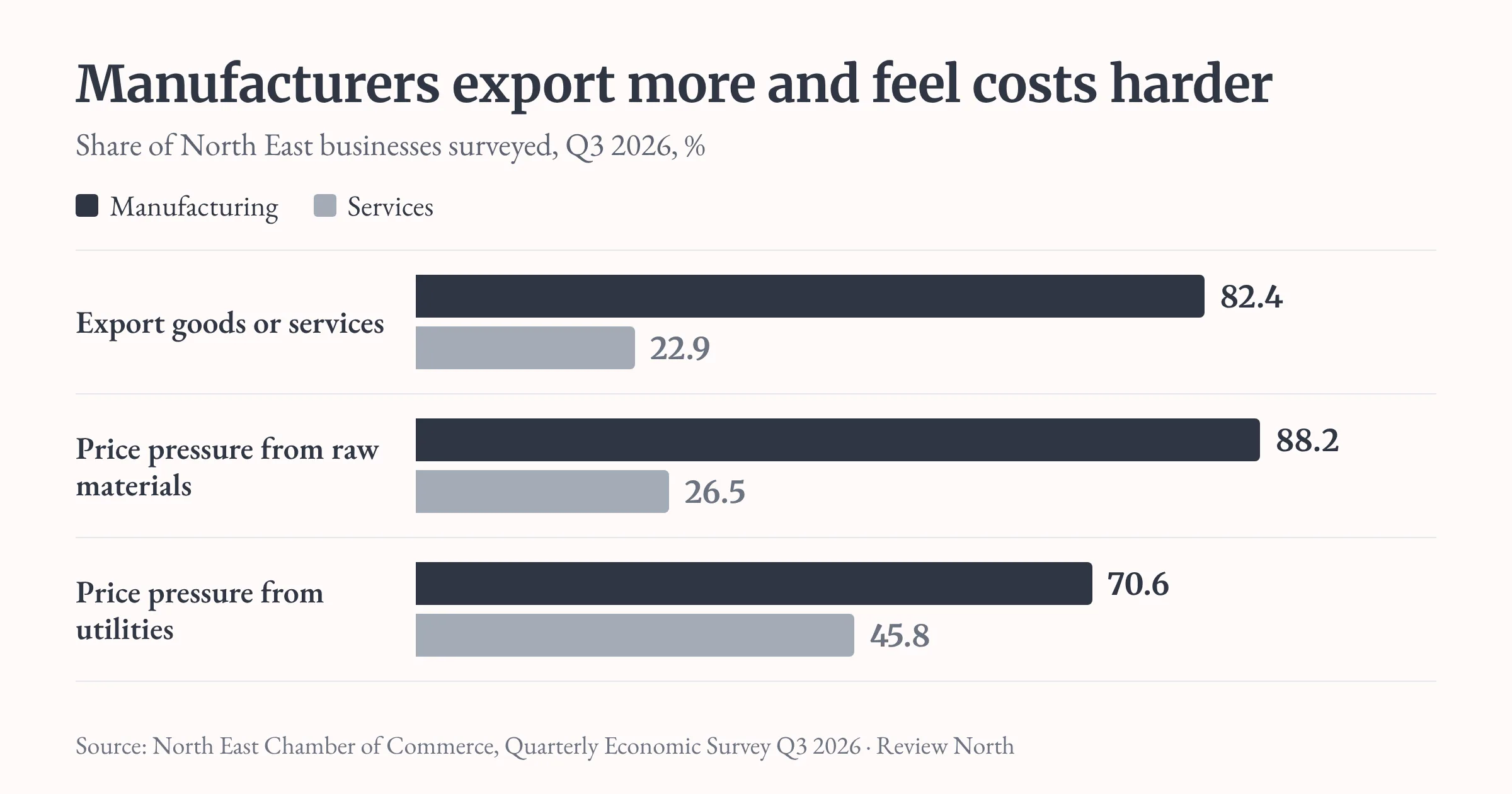
The distinction is particularly relevant to the North East's export economy. Some 82.4% of manufacturing respondents said they exported goods or services, compared with 22.9% of services firms.
The survey covered 100 businesses, and the published sector percentages suggest that approximately 17 were manufacturers and 83 were services firms. Those numbers are inferred from the tables rather than published by the Chamber.
The manufacturing results therefore rest on a small sample and cannot establish how far the pattern extends across the region's manufacturing sector.
North East Chamber of Commerce president Natasha McDonough acknowledges the pressures facing businesses in the survey's foreword.
“UK sales and orders have weakened this quarter, while businesses remain cautious about future workforce growth,” she says.
What businesses want from the Budget
The increased concern about taxation and business rates comes as the Chamber presses the Treasury for measures intended to improve conditions for investment.
Its September Budget submission called for a fairer business rates system, improved access to finance and support for innovation, alongside changes to skills provision, energy and infrastructure.
In the submission, a letter to Chancellor John Healey, Chamber chief executive John McCabe asks the government to “avoid further tax increases on business” and says the Budget should deliver “the root-and-branch reform of business rates promised by the government”.
The distinction between reforming business rates and devolving their revenue is important. As Review North reported in August, the government's plans to allow mayors to retain a greater share of locally generated business rates do not change how the tax itself is calculated.
The survey also recorded continued cost pressures. Other overheads were cited by 57% of businesses, an increase of 9.7 points from the previous quarter, while 56% identified labour costs as a pressure.
National investment remains weak
The manufacturing findings match the national picture in the British Chambers of Commerce's third-quarter survey.
That survey, based on responses from more than 4,300 UK businesses, found that only 17% planned to increase investment in plant, machinery or equipment over the following three months. The figure was unchanged from the second quarter and remained at its lowest level since the pandemic. Another 22% planned to reduce investment.
Nationally, 47% expected turnover to increase over the next 12 months, up from 44% in the previous quarter. That improvement in confidence had not translated into stronger investment intentions.
The North East survey was conducted between 17 August and 14 September 2026, about six weeks before the Budget.
“The Budget is an important opportunity for government to address the barriers businesses face and give them greater confidence to invest and trade,” says North East Chamber of Commerce deputy chief executive Rhiannon Bearne.
The Chancellor is due to deliver the Budget on 28 October.
THE BRIEFING
The North East economy, every Thursday at 9am. Free.
Read our privacy notice.